When I tell people that I do boudoir photography, I often get two reactions: a curious nod – or a puzzled “Bou… what?”. No wonder: the word conjures up images of perfume, silk and old novels. And indeed, this single term holds a history stretching back over 250 years.
Let’s take a little journey: from the French Rococo period, through the earliest photographs, to what the boudoir is today.
A room for sulking
The word ‘boudoir’ originates from 18th-century French and is derived from the verb ‘bouder’ – ‘to sulk’. Literally, therefore, a boudoir is a ‘sulking room’. The word has been recorded in English since 1777.
What was meant was a small, private room where a lady could retreat: to get dressed, to read and write, to be alone, or to receive close friends. Unlike the formal salons, the boudoir was not a place for the public, but a place for herself.
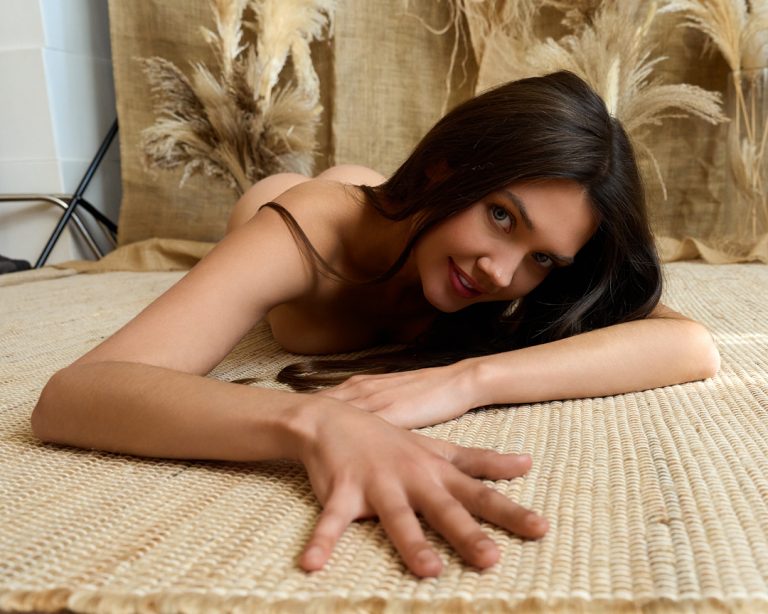
It is precisely this idea that still lies at the heart of boudoir photography today: a safe space where a woman does not pose for others, but is allowed to present herself as she sees herself.
Before cameras existed: painting
Long before anyone invented the camera, painters had already explored this subject. The reclining, relaxed woman in an intimate setting is one of the oldest motifs in European art:
- In 1538, Titian painted *Venus of Urbino*: a woman reclining on a bed, gazing calmly and confidently at the viewer.
- Around 1752, François Boucher painted *The Sleeping Girl*, which now hangs in the Alte Pinakothek in Munich – boudoir art right on our doorstep, so to speak.
- In 1767, Jean-Honoré Fragonard painted *The Swing*, a playful painting typical of the Rococo style.
- Around 1800, Francisco de Goya painted *The Naked Maja* – one of the first major European paintings of a naked woman who is not depicted as a goddess or a figure from mythology.
- Jean-Auguste-Dominique Ingres painted *The Grand Odalisque* in 1814.
- Édouard Manet caused a scandal at the Paris Salon in 1865 with his painting *Olympia*: she looks directly at the viewer without the slightest hint of modesty.
What fascinates me about these pictures is not so much the nudity as the pose. Titian, and later Manet, also painted women looking back. To me, that self-assured gaze remains, to this day, the heart of a good boudoir photograph.
1839: The advent of photography – and with it, the nude
In 1839, Louis Daguerre presented the first practical photographic process, the daguerreotype, in Paris. It was not long before photographers began to take nude studies as well.
Officially, they served as so-called ‘Académies’: study models for painters wishing to draw the human body. In France, such images had to be registered with and approved by the authorities. However, many of these early photographs possess a sensuality that goes far beyond mere study material. From the mid-1850s onwards, photographic nudes were scarcely ever officially registered as ‘Académies’; much of the trade moved underground.
Around 1900 came the famous ‘French postcards’, which were often sold on the black market. Intimacy had thus finally become part of photography – though almost always created by men, for men.
The 1920s: glamour, light and newfound freedom
After the First World War, the image of women changed rapidly. Short hair, shorter dresses, a newfound confidence in their demeanour. Photography, too, became bolder and more elegant.
In New York, from around 1917 onwards, Alfred Cheney Johnston photographed the showgirls of the Ziegfeld Follies – often in elaborate costumes, using a large-format camera and with a flair for light and fabric that can still be seen today in many boudoir photographs.
In Berlin in 1925, the photographer Yva (Else Neuländer-Simon) opened her own studio near Kurfürstendamm. She photographed fashion, portraits and nudes, experimented with dreamlike multiple exposures and began working in advertising at an early stage. In 1936, she took on a young assistant: Helmut Neustädter, who would later become world-famous as Helmut Newton. Yva’s story ends tragically: the Nazi regime banned her from working in 1938; she was deported in 1942 and is believed to have been murdered that same year. The fact that a woman in 1920s Berlin took sensual photographs as a matter of course is, for me, one of the most beautiful and, at the same time, saddest chapters in this story.
The Pin-up Era: A Smile Over the Shoulder
In the 1940s, a single photograph became the symbol of an entire generation: the actress Betty Grable in a swimsuit, photographed from behind, with a mischievous glance over her shoulder. It was taken by the studio photographer Frank Powolny, probably in early 1943. The film studio distributed millions of prints, and it is estimated that one in five American soldiers serving overseas carried the picture with them.
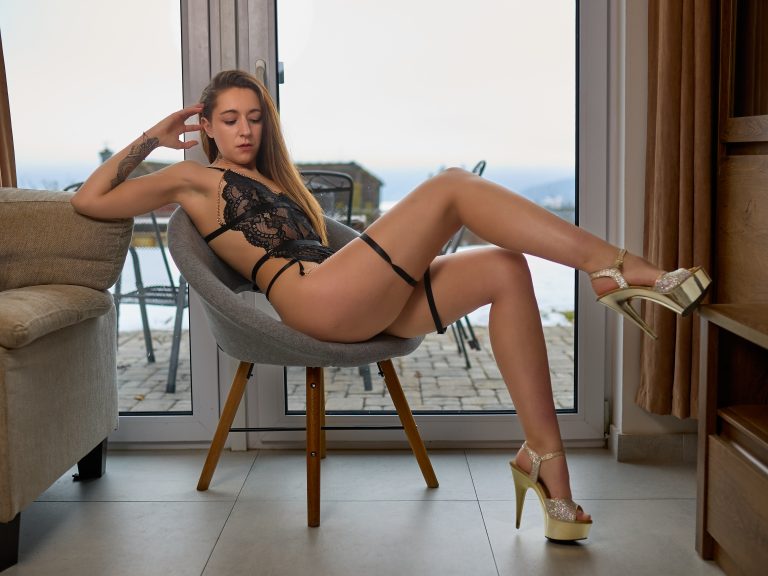
Pin-ups were playful, cheerful and more suggestive than revealing. I still use many of the poses from that era – the glance over the shoulder, the slightly bent leg, the hand in the hair – to this day, because they are simply timelessly beautiful.
One notable figure from this period is Bunny Yeager. She was a model herself, taught herself photography, and in 1954 photographed the legendary Bettie Page in Florida, including in her famous leopard-print swimsuit. A woman behind the camera who portrayed women as both sensual and self-assured – that was anything but commonplace in the 1950s.
The 1980s and 90s: glamour for everyone
For a long time, sensual photography was the preserve of film stars, showgirls and magazines. That changed in the 1980s and 1990s: suddenly, ordinary women could book a professional glamour shoot.
The best-known example is the American chain Glamour Shots, which opened its first studio in Dallas in 1988 and had around 380 branches by the mid-1990s – often in shopping centres. Make-up, big hairstyles, multiple outfits, soft-focus effects: from today’s perspective, much of it feels like a time capsule. But the idea behind it was revolutionary: every woman should be allowed to feel like a star for once.
It was also during this period that boudoir photography, as we know it today, became popular in the USA. Initially, it was often given as a gift: brides would have their photograph taken before the wedding and present their partner with a small, private album.
The digital age: from a surprise for him to a gift for yourself
With the advent of digital photography and, later, social media, the genre has undergone yet another fundamental transformation. I consider three developments to be particularly important:
- Women have their photos taken for themselves. These days, the most common reason for a photo shoot is no longer to give a gift to a partner, but the desire to see themselves in a new light – for a birthday, after a break-up, following an illness, or just because.
- Real bodies rather than ideals. The concept of ‘body positivity’ has broadened our perspective. Boudoir photography is no longer just for young, slim women, but for people of all ages and body types.
- Self-determination as the foundation. Clear agreements, boundaries that are respected, and written consent prior to any publication are now standard practice in the industry. This is what most clearly distinguishes modern boudoir photography from its history, in which women were usually merely subjects and rarely had a say in the matter.
In Germany, too, boudoir photography has evolved in recent years from an insider’s secret into a recognised genre in its own right – with many female photographers and a few male photographers practising it with great respect.
What’s in my studio today
When I look back at this story, I find little traces of it in almost every photoshoot:
- The boudoir as a space: a sheltered, cosy place where it’s all about you,
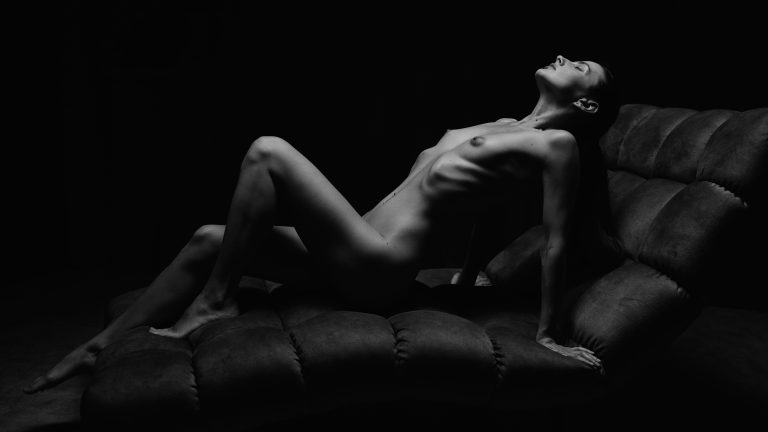
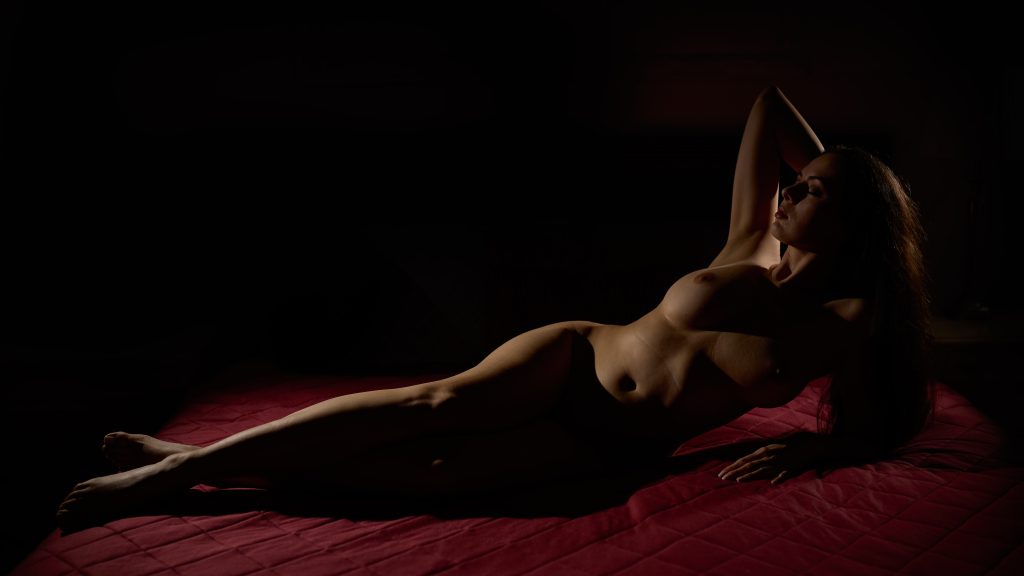
- the painting: soft, oblique light and the tranquillity of a reclining pose,
- The 1920s: fabrics, lace and the interplay of light and shadow,
- The pin-ups: the look over the shoulder and a wink,
- And today: you decide how far you go, which images remain, and whether anyone gets to see them at all.
What has changed most over the past 250 years is not technology, but the question of who is in charge. In the past, women were painted and photographed. Today, you decide for yourself how you want to be seen. And that is exactly what I find so beautiful about this photograph.
Fancy experiencing a bit of this story for yourself?
Whether it’s a touch of Rococo, a pin-up look or something completely modern and minimalist: let’s find out which style suits you best during our initial consultation. There’s no obligation – we can chat over a coffee in the studio or on the phone.